Complete pump-outFOG, liquids, and settled solids

Condition reviewBaffles, tees, lids, access, and defects

Designed installationLoad, fixtures, access, and authority review

Controlled handlingTransport and approved disposal documentation

Grease-system services

Protect the kitchen, the drain line, and the sewer system.

A grease interceptor works only when it is properly selected, connected, accessible, maintained, and emptied before accumulated fats, oils, grease, and solids reduce its effective capacity.

Grease Trap Pumping

Scheduled or one-time pumping for accessible hydromechanical and gravity grease interceptors, with site-specific preparation and handling.

  • Remove accumulated FOG and solids
  • Confirm access and service conditions
  • Transport contents for approved disposal
Schedule pumping →

Cleaning & Inspection

Authorized interior cleaning and a practical condition review after contents are removed and internal components are visible.

  • Baffles, tees, lids, seals, and walls
  • Inlet and outlet observations
  • Photos and noted deficiencies
Request inspection →

Maintenance Programs

Recurring service built around actual accumulation, operating conditions, manufacturer guidance, and the governing wastewater authority.

  • Defined frequency and access plan
  • Service history and documentation
  • Escalation for defects or high loading
Build a program →

New Installation

Planning and installation for approved grease interceptors based on connected fixtures, flow, food-service operation, location, and code requirements.

  • Hydromechanical and gravity systems
  • Approved fixture connection schedule
  • Permit, inspection, and startup plan
Plan installation →

Replacement & Upgrades

Replace failed, inaccessible, undersized, damaged, or noncompliant equipment after verifying the existing system and current approval requirements.

  • Existing conditions and load review
  • Access, piping, venting, and controls
  • Removal and restoration responsibilities
Discuss replacement →

Grease-Waste Drain Support

Evaluation, cleaning, repair, or replacement planning for the approved grease-waste piping serving the interceptor.

  • Recurring blockage investigation
  • Camera or access review where practical
  • Repair scope separated from pumping
Request line service →
Grease trap pumping

Removing the top layer is not a complete pump-out.

Grease systems separate light FOG at the top and heavy solids at the bottom. Effective pumping addresses the full contents and makes the internal condition visible for inspection.

01

Secure and access

Confirm service location, protect the work zone, open approved access points, and assess immediate conditions.

02

Pump the full contents

Remove FOG, wastewater, and settled solids in accordance with the authorized service scope.

03

Inspect visible components

Document accessible baffles, tees, walls, lids, seals, and conditions requiring repair or further evaluation.

04

Close, document, and transport

Secure access, record service details, and transport the material to an approved receiving or disposal facility.

Schedule Grease Pumping →
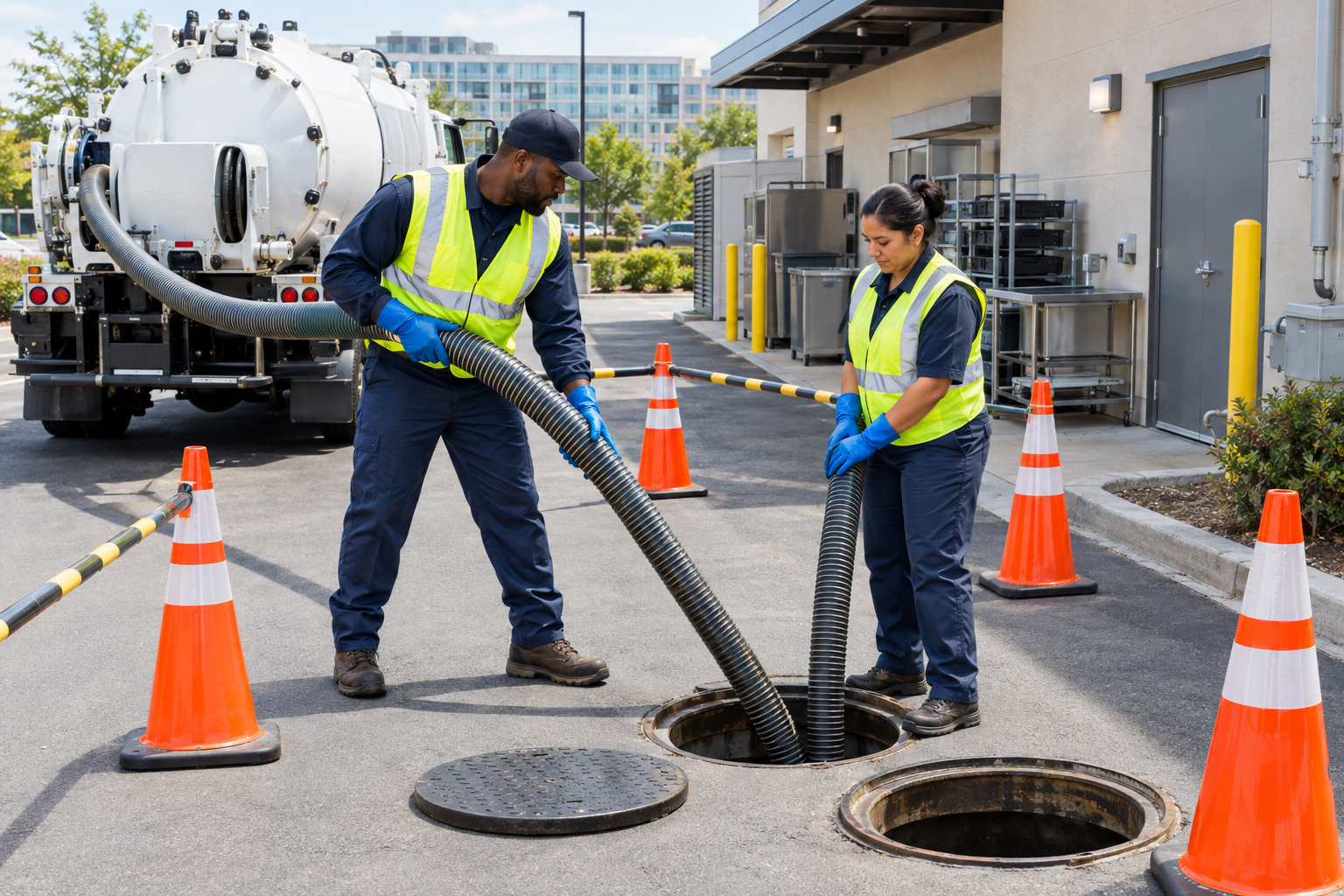
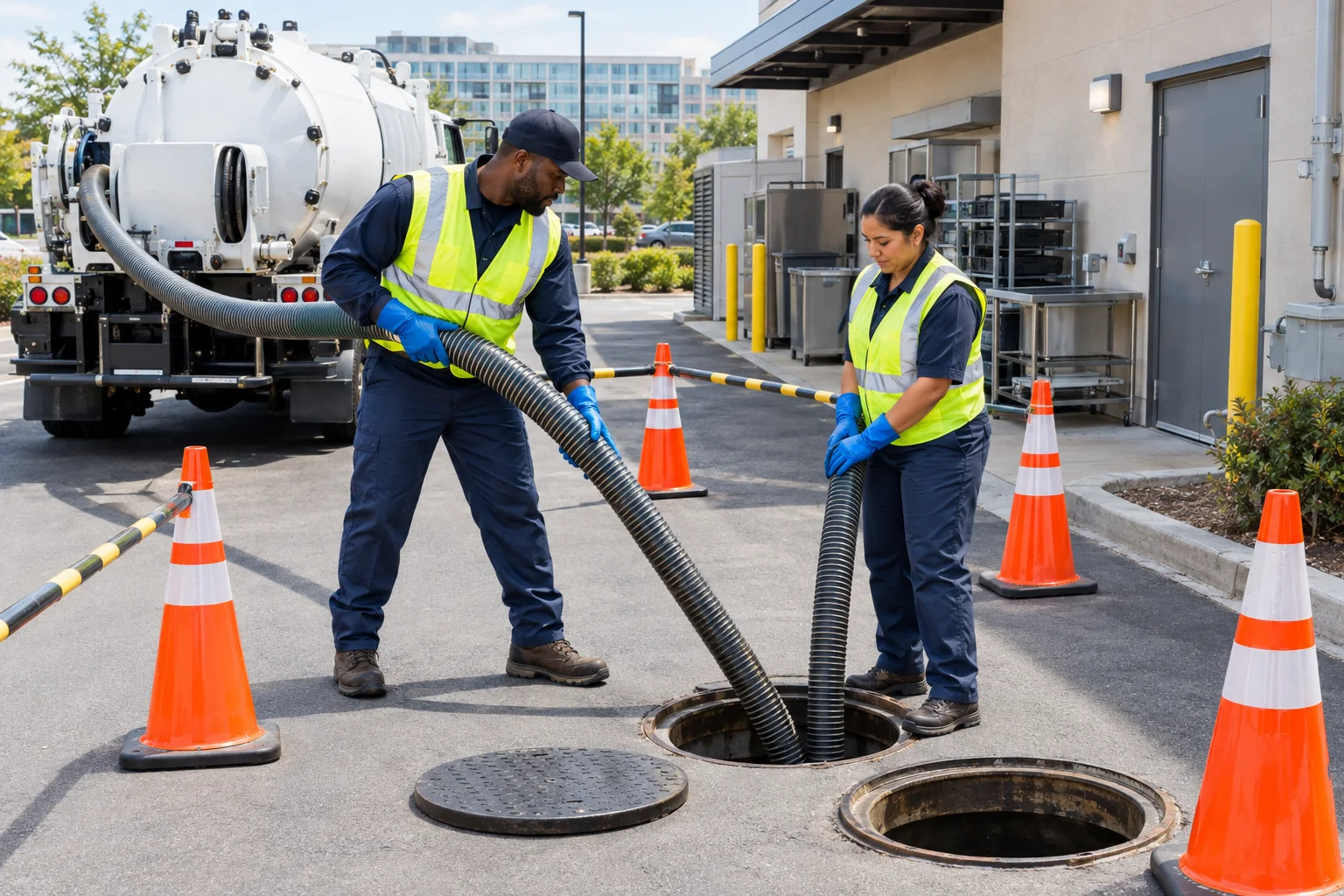
Commercial grease interceptor pump-out with protected access area and vacuum equipment
Service records that support operationsAccess · pump-out · condition notes · closeout
Grease interceptor installation

Choose the system by the load—not the available corner.

“Grease trap” is a common term for different devices. The approved equipment, size, fixture connections, location, and maintenance access must match the food-service operation and governing requirements.

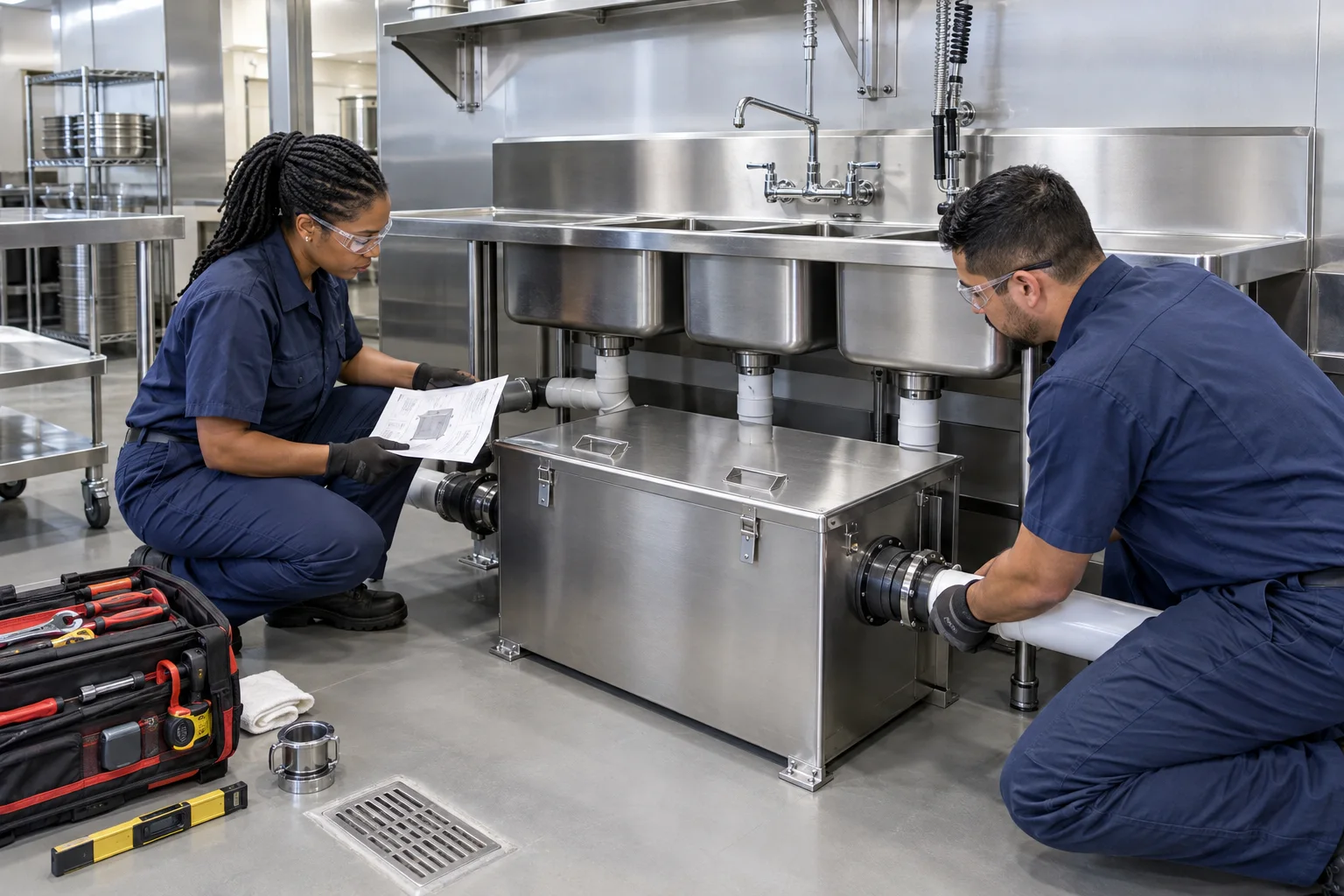
Plumbers installing an accessible hydromechanical grease interceptor in a commercial kitchen
Interior or point-of-use equipment

Hydromechanical Grease Interceptor

Compact listed equipment that uses flow control and internal separation features. Selection must follow the approved fixture flow, manufacturer listing, installation instructions, ventilation, access, and wastewater-authority requirements.

  • Serviceable access and clearances
  • Approved flow-control arrangement
  • Connected fixtures confirmed by the AHJ
Plan an HGI installation →
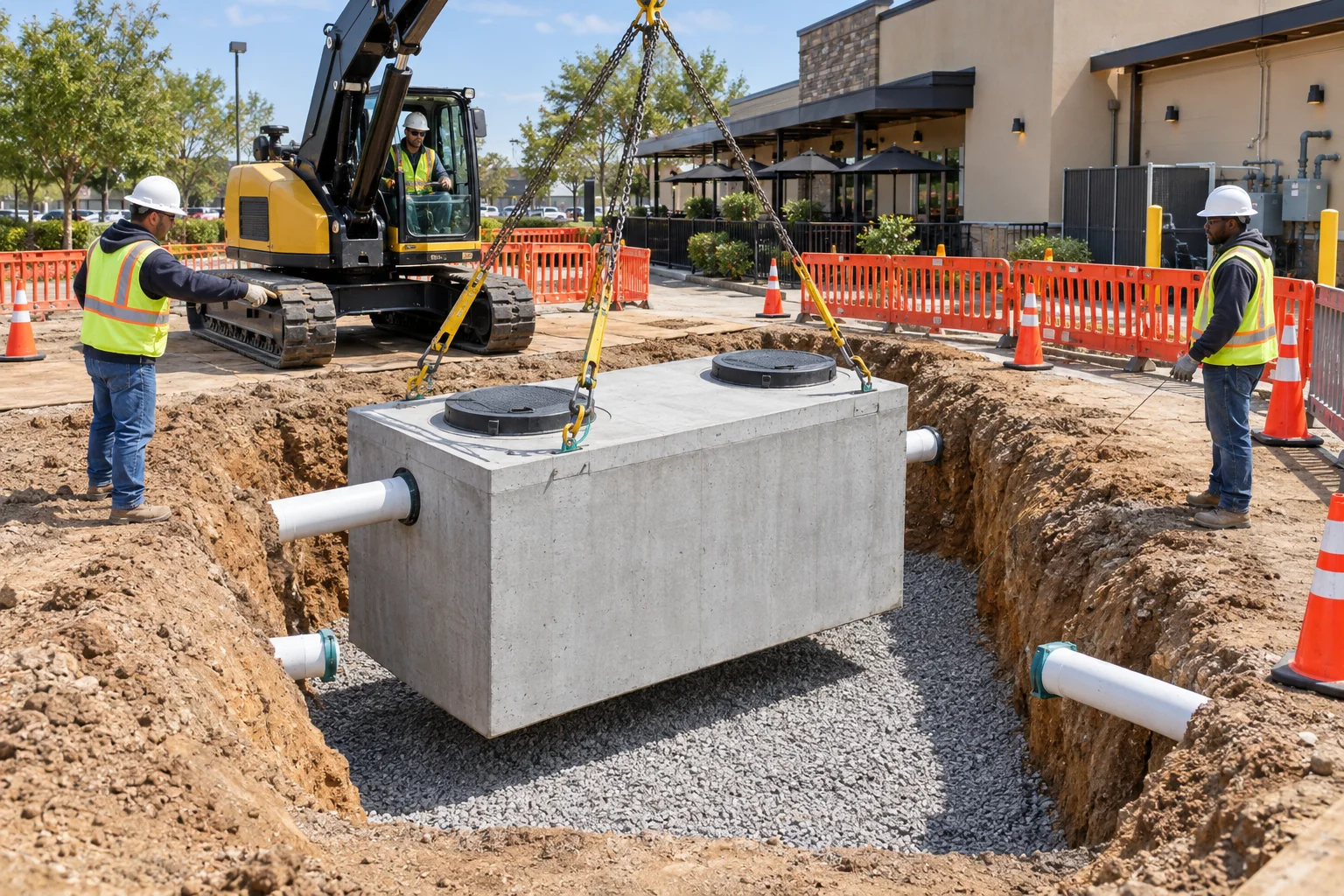
Crew setting a large precast gravity grease interceptor in a prepared commercial excavation
Exterior or high-capacity equipment

Gravity Grease Interceptor

Large-volume equipment typically installed underground. Design must account for capacity, invert elevations, structural loading, access covers, groundwater or buoyancy, excavation, traffic rating, sampling, pumping access, and restoration.

  • Tank, elevations, and piping coordinated
  • Safe long-term pumping access
  • Structural and site conditions verified
Plan a gravity interceptor →
Installation design factors

The interceptor is one part of a complete grease-waste system.

Final selection and installation must follow the adopted plumbing code, wastewater or FOG-control authority, permit, approved plans, manufacturer listing, and actual site conditions.

Request Site Evaluation →
01

Food-service operation

Menu, production, hours, seating, warewashing, and expected FOG and solids loading.

02

Connected fixtures

Approved sink, drain, dishwasher, disposal, and equipment connection schedule—never assumed.

03

Capacity and flow

Fixture flow, retention, manufacturer rating, code sizing method, and wastewater-authority criteria.

04

Piping and controls

Grease waste, venting, flow controls, cleanouts, sampling points, and required monitoring provisions.

05

Access and maintenance

Safe opening, pumping, inspection, replacement, clearance, odor control, and equipment access.

06

Site and structure

Elevation, excavation, utility conflicts, groundwater, traffic loads, supports, haul-off, and restoration.

Warning signs

Grease problems rarely improve by waiting.

Overflow, odor, slow drainage, frequent line cleaning, and damaged components can indicate overdue pumping, excessive loading, a failed interceptor, or a separate piping problem.

Request Grease-System Service →
01

Slow kitchen drainage

Sinks, floor fixtures, or grease-waste branches drain slowly or back up during peak use.

02

Odor or surface grease

Persistent odors, grease around access covers, or evidence of overflow requires prompt review.

03

High accumulation

FOG and solids reduce the interceptor’s effective working volume before the scheduled service date.

04

Damaged components

Missing baffles, deteriorated tees, failed lids, corrosion, cracks, or unsafe access affect performance.

05

Repeated violations

Wastewater notices, failed inspections, or poor service records indicate a program or equipment gap.

06

Operational changes

New menus, equipment, hours, seating, or production can increase loading beyond the original basis.

Restaurants, institutions & portfolios

Build the pumping schedule around evidence and requirements.

Service frequency should follow the controlling wastewater authority, permit, manufacturer requirements, actual FOG and solids accumulation, operating changes, and site history—not a generic calendar alone.

Build a Maintenance Program →
01

Baseline service

Document equipment, access, capacity, condition, accumulation, current schedule, and open defects.

02

Operating schedule

Coordinate service windows, keys, alarms, loading docks, traffic, odors, and kitchen shutdowns.

03

Compliance records

Maintain service dates, quantities where available, condition notes, photos, receiving records, and repairs.

04

Frequency adjustment

Shorten or extend intervals only when authority requirements and documented accumulation support the change.

Grease-service process

From site intake to documented closeout.

Pumping and installation follow different field paths, but both begin with clear access, authority requirements, and an approved scope.

1

Identify the system

Confirm property, equipment type, capacity, location, access, service history, and immediate condition.

2

Define requirements

Review authority, permit, disposal, fixture, design, access, schedule, and site responsibilities.

3

Approve the scope

Separate pumping, cleaning, repairs, installation, excavation, restoration, and third-party work.

4

Perform authorized work

Protect the site, complete the approved service, and document concealed or changed conditions.

5

Inspect and close out

Secure covers, verify operation where applicable, record service, and identify remaining actions.

Grease trap questions

Clear answers before service begins.

These general answers help with planning. The adopted code, wastewater or FOG authority, permit, manufacturer instructions, approved design, and site conditions control the actual work.

Questions?240.392.3535
How often should a grease trap or interceptor be pumped?+

The required interval varies. Follow the controlling wastewater authority, discharge permit, manufacturer, and actual accumulation. Many programs use a FOG-plus-solids threshold—often called a 25% rule—but the local requirement and documented site condition control.

Is a grease trap the same as a grease interceptor?+

“Grease trap” is often used generally. Hydromechanical grease interceptors are typically smaller, listed devices using flow and separation features. Gravity grease interceptors are generally larger tanks relying on volume and retention time. Approval and sizing differ.

Do you remove all contents or only the floating grease?+

A complete pump-out addresses floating FOG, liquid contents, and settled solids within the authorized service scope. Removing only the top layer leaves solids and reduces the ability to inspect the equipment.

Can chemicals, bacteria, or enzymes replace pumping?+

Do not treat additives as a substitute for required pumping. Their use may be restricted by the wastewater authority and can move grease downstream rather than remove it from the system. Use only products and methods specifically allowed for the site.

Which kitchen fixtures should connect to the interceptor?+

The approved connection schedule depends on the adopted code, wastewater authority, plans, equipment, and food-service operation. Sinks, dishwashers, disposals, floor fixtures, and other equipment should never be assumed connected or excluded without review.

Can you install an interceptor in any convenient location?+

No. Location must support approved drainage, venting, flow control where required, structural loading, safe access, pumping, odor control, inspection, clearances, excavation, utilities, and future replacement.

Where does the pumped grease waste go?+

Pumped contents must be transported and delivered to an approved receiving, treatment, recycling, or disposal facility in accordance with applicable hauler, wastewater, environmental, and recordkeeping requirements. It is not disposed of onsite.
Request grease-system service

Tell us what your kitchen and interceptor need.

Share the property, equipment type, size if known, service history, access, symptoms, and operating schedule. For an active overflow or backup, call directly.

Call for service240.392.3535
  • One-time and recurring pumping
  • Cleaning, inspection, and documentation
  • Installation, replacement, and upgrade planning